
For decades, investors have been told that a portfolio consisting of 60% stocks and 40% bonds offers a reasonable balance between growth and stability. Stocks provide the upside, bonds provide the protection, and the combination supposedly allows investors to weather economic storms without taking unnecessary risks.
It's a simple strategy. And for much of the past several decades, it worked remarkably well.
I believe that era is over.
Not because stocks have stopped producing wealth, or because bonds have suddenly become worthless. The problem is that the monetary environment that made the traditional 60/40 portfolio so effective has changed.
For much of the period following the 2008 financial crisis, investors became accustomed to a world in which falling interest rates supported asset prices, central banks intervened when markets stumbled, and bonds generally provided protection when equities declined.
But what happens when inflation prevents central banks from coming to the rescue without creating an entirely new set of problems?
I think the answer can be illustrated by something from aviation known as a phugoid cycle.
The Phugoid Cycle
In aviation, a phugoid is a long-period oscillation in which an aircraft repeatedly exchanges altitude for airspeed.
The aircraft climbs, gradually loses speed, lowers its nose, accelerates during the descent, and eventually begins climbing again. Under normal circumstances, these oscillations are generally stable or can be controlled.
But imagine something more troubling.
Imagine the aircraft has lost its engines.
An airplane without engine power doesn't immediately fall out of the sky. It can still glide. By lowering its nose, the aircraft sacrifices altitude to gain airspeed. With that additional speed, it can raise its nose and temporarily climb again.
The problem is that it has no way to replace the energy being lost to aerodynamic drag.
Every descent costs altitude. Every climb consumes airspeed. Pull the nose up too aggressively, and the aircraft can stall, forcing another descent to regain speed.
What looks like a recovery may be little more than another temporary exchange of altitude for airspeed.
A tragic example of uncontrolled phugoid oscillations occurred during Japan Airlines Flight 123 in 1985. Its engines hadn't failed. Instead, catastrophic structural damage disabled the aircraft's hydraulic flight controls, leaving the pilots attempting to control it through engine thrust alone. For approximately half an hour, they fought severe oscillations before the aircraft ultimately crashed into mountainous terrain.[1]
The circumstances were different from an engine failure, but the accident demonstrated how dangerous these oscillations can become when an aircraft loses its normal means of control.
Now consider the economy.
In a healthy economic environment, the engines of sustained growth are productivity, innovation, private investment, and rising real wages. These are the forces that create lasting prosperity through increases in actual economic output.
Those engines haven't disappeared. But since 2008, our financial system has become increasingly dependent on monetary intervention to sustain economic activity, support asset prices, and manage an enormous accumulated debt burden.
In effect, we've become accustomed to relying on artificial thrust whenever the economy begins losing altitude.
That thrust comes primarily through lower interest rates, easier credit conditions, and, during extraordinary periods, direct liquidity injections.
When economic conditions deteriorate, the Federal Reserve responds by making borrowing cheaper. Credit expands, asset prices recover, spending increases, and economic activity accelerates.
The aircraft begins climbing again.
But sufficiently accommodative financial conditions can also encourage excessive borrowing, speculative asset valuations, and inflationary pressures. Monetary policy isn't the only cause of inflation, of course. Supply disruptions, fiscal policy, and other forces also matter. But inflation creates a particularly difficult problem for a financial system that has become sensitive to higher rates.
The Federal Reserve finds itself tightening monetary policy to contain rising prices. Borrowing becomes more expensive. Asset valuations come under pressure. Businesses postpone investment, consumers reduce spending, and refinancing becomes increasingly difficult.
The aircraft is climbing, but it's losing airspeed.
Push rates high enough, and financial conditions can deteriorate until something in the system begins to break.
The Federal Reserve is then pressured to reverse course.
Rates fall, liquidity returns, and the economy attempts another recovery.
And the cycle repeats.
Interest-rate cuts can provide genuine economic relief. They can support employment, investment, and spending. But cheaper money alone cannot manufacture sustained productivity growth or make accumulated debt disappear.
It can stimulate demand. It can buy time.
Whether the economy's underlying engines have actually recovered is another question entirely.
My concern is that the extraordinary monetary interventions following 2008, and later the pandemic, have left us with a financial system increasingly sensitive to the very interest-rate adjustments needed to control inflation.
Every policy decision seems to introduce another difficult trade-off.
And I question how long we can continue assuming that central banks will always have enough room to maneuver.
The phugoid cycle isn't a formal economic model, and I certainly don't pretend that every monetary cycle must end in disaster. It's simply how I've come to think about the growing tension between short-term financial relief and the long-term health of an increasingly indebted system.
When Bonds Stop Protecting Stocks
This brings us back to the traditional 60/40 portfolio.
The strategy has historically benefited from a relatively simple relationship: when stocks decline, high-quality government bonds often appreciate.
For much of the period following 2000, that relationship provided investors with an effective counterweight to equity risk. Economic weakness generally encouraged lower interest rates, Treasury yields declined, and bond prices increased.
But that negative stock-bond correlation is not permanent. It depends heavily on the inflationary environment.
In fact, research published by economists at the Federal Reserve in October 2026 reached a similar conclusion. Their analysis found that government bonds' ability to protect portfolios depends significantly on inflationary pressures and the nature of the economic shock. When inflation is elevated, central banks may be unable to ease monetary policy in response to economic weakness without jeopardizing price stability.[2]
In those circumstances, stocks and bonds can decline together.
We saw this firsthand in 2022.
The S&P 500 declined approximately 18% on a total-return basis, while the Bloomberg U.S. Aggregate Bond Index lost approximately 13%.
Suddenly, the asset that was supposed to protect the portfolio needed protection of its own.
What I find particularly interesting is that the damage extended well beyond conventional 60/40 portfolios.
Bridgewater Associates, founded by Ray Dalio, developed its All Weather strategy around the philosophy of risk parity: balancing exposure to different economic environments rather than simply allocating capital between stocks and bonds.
Yet Bridgewater's institutional All Weather strategy targeting 10% volatility reportedly lost approximately 22% in 2022, according to performance materials presented to the Indiana Public Retirement System.[3]
Think about that.
A sophisticated institutional strategy designed around diversification across economic regimes lost more than a fifth of its value during an inflation-driven tightening cycle.
To me, the lesson isn't that diversification has stopped working. It's that the relationships investors depend upon can change, sometimes precisely when they need them most.
And while government bonds may regain their defensive characteristics in a lower-inflation environment, that's hardly a relationship I'd want to take for granted.
The Problem With Treating Bonds as Safe
Bonds aren't inherently safe simply because they're called fixed income.
They carry interest-rate risk, inflation risk, and, depending on the issuer, credit and default risk.
Long-duration bonds are especially sensitive to changes in interest rates. Even government securities backed by the full faith and credit of the United States can experience substantial market losses when yields rise.
Corporate bonds introduce another complication. During periods of financial stress, credit spreads can widen at the same time equities are declining.
Investors who thought they had diversified their risk may discover that both sides of their portfolio are responding to the same underlying economic forces.
None of this means bonds are useless.
Short-term Treasuries, for example, can still play an important role in liquidity management and capital preservation. And there will undoubtedly be environments in which longer-duration bonds once again perform exceptionally well.
But that raises an interesting question.
Why not simply replace longer-duration bonds with short-term Treasuries and avoid much of the interest-rate risk altogether?
The answer comes down to the difference between preserving capital and actually offsetting losses elsewhere in a portfolio.
Much of the historical diversification benefit of government bonds came from their tendency to appreciate when stocks declined and interest rates fell. That effect generally becomes more pronounced as duration increases, because longer-duration bonds are more sensitive to changes in yields.
Short-term Treasuries can provide stability and income, but their prices typically don't rise nearly as much when yields fall.
Intermediate- and longer-duration bonds, on the other hand, have historically offered more meaningful capital appreciation during certain equity bear markets.
And therein lies the problem.
The very interest-rate sensitivity that once made longer-duration bonds such effective portfolio hedges can become their greatest liability when inflation forces rates higher.
Reduce duration, and you generally reduce both the interest-rate risk and the potential price appreciation from falling yields.
Increase duration, and you potentially improve the portfolio's protection during a deflationary recession while simultaneously increasing its vulnerability to an inflation-driven tightening cycle.
It's a trade-off that I don't believe receives nearly enough attention.
I no longer believe that automatically allocating 40% of a long-term investment portfolio to conventional bonds is necessarily the most effective way to manage risk.
Not when inflation can undermine both sides of the portfolio simultaneously.
Why I Favor Managed Futures
This is where managed futures become particularly interesting.
Unlike a conventional bond allocation, managed-futures strategies can take both long and short positions across multiple asset classes, including equities, fixed income, currencies, and commodities.
Many use systematic trend-following techniques to identify sustained market movements and adjust their positions accordingly.
Consider an environment in which inflation is accelerating, interest rates are rising, and bond prices are falling.
A traditional bond allocation generally loses value as yields rise, particularly if it holds longer-duration securities.
A managed-futures strategy, on the other hand, may be positioned to profit from declining bond prices. It might also benefit from rising commodity prices or sustained weakness in equity markets.
And when those trends eventually reverse, the strategy can adjust its positioning.
That's the distinction I find compelling.
Traditional diversification often depends on certain assets maintaining a favorable relationship with one another. Trend-following strategies attempt to adapt to changing market conditions instead.
They aren't dependent on being permanently long stocks or bonds, or on interest rates moving in a particular direction.
And the idea isn't supported by one fund's recent performance alone.
Research published in the Journal of Financial Economics in 2012 documented time-series momentum across dozens of futures and forward markets. A subsequent study by AQR researchers examined trend-following strategies using historical evidence extending back to 1880, finding that the approach had produced positive average returns across a broad range of economic environments.[4][5]
Those historical reconstructions aren't the same thing as an investable fund's realized performance, but they suggest that the underlying strategy deserves consideration beyond the events of 2022.
Of course, managed futures have risks of their own.
They can struggle during sideways markets, abrupt reversals, and periods when trends fail to develop. They may use leverage and derivatives, introducing liquidity, counterparty, and execution risks. They can also take substantial directional exposures that work against them.
They aren't guaranteed to protect a portfolio during every equity selloff.
But they offer something I think is becoming increasingly valuable: a potential source of returns that isn't entirely dependent on rising asset prices or declining interest rates.
And importantly, they don't require investors to maintain permanent long-duration or credit exposure simply to pursue diversification.
What the Numbers Suggest: Bonds vs. DBMF, 2019–2026
DBMF, an exchange-traded fund that seeks to replicate the pre-fee performance of the largest managed-futures hedge funds, began trading in May 2019. That gives us a little more than seven years of actual fund history to examine.
Consider several hypothetical portfolios beginning at the end of that month.
Rather than comparing only a traditional 60/40 portfolio against a 70/30 managed-futures allocation, I also wanted to see what happens when we keep the equity weighting identical and simply replace the bonds with managed futures.
Using monthly rebalancing and reinvested distributions from June 2019 through October 20, 2026, the approximate results were:[6]
| Portfolio | Total return | 2022 | 2026 YTD |
|---|---|---|---|
| 60% VOO / 40% AGG | +108.0% | −15.8% | +7.5% |
| 60% VOO / 40% DBMF | +171.3% | −2.6% | +15.9% |
| 70% VOO / 30% AGG | +130.9% | −16.4% | +9.0% |
| 70% VOO / 30% DBMF | +182.5% | −6.6% | +15.4% |
| 100% VOO | +213.0% | −18.2% | +13.7% |
Hypothetical, dividend-adjusted returns, May 31, 2019–October 20, 2026, rebalanced monthly; October 2026 is a partial month.
This essay reflects my personal views and is not investment advice or a recommendation to buy or sell any security.
Positions Disclosure: At the time of writing, I hold no direct positions in VOO, AGG, or DBMF. My household maintains S&P 500 exposure through mutual funds held in a workplace retirement account.
in 2022
in 2022
matched equity weight
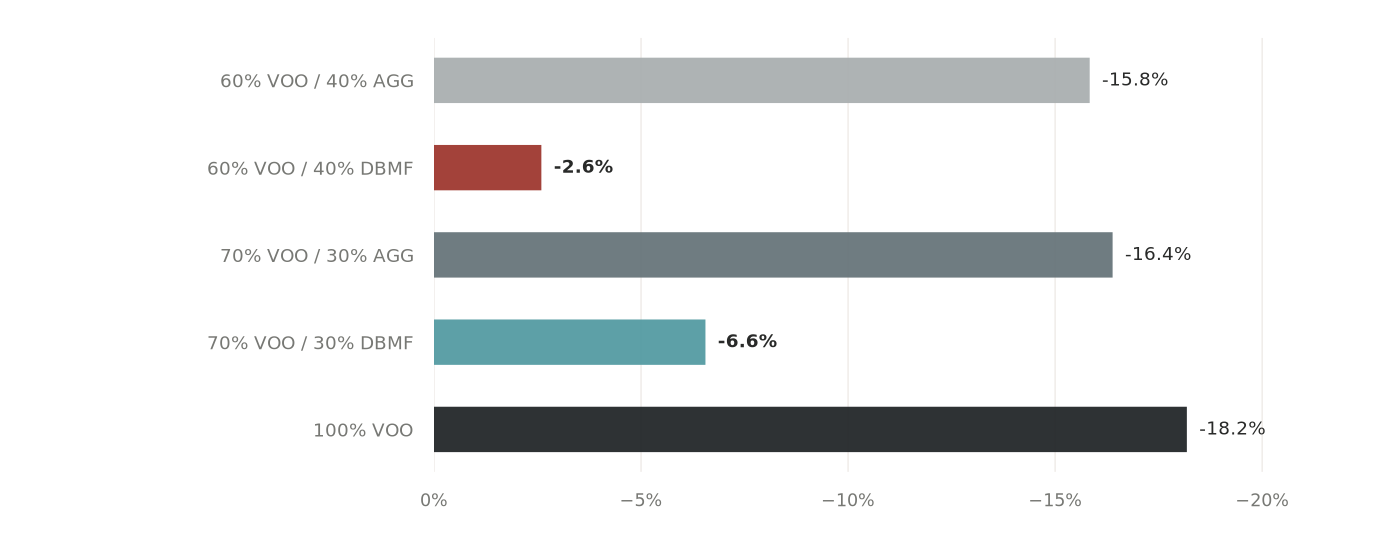
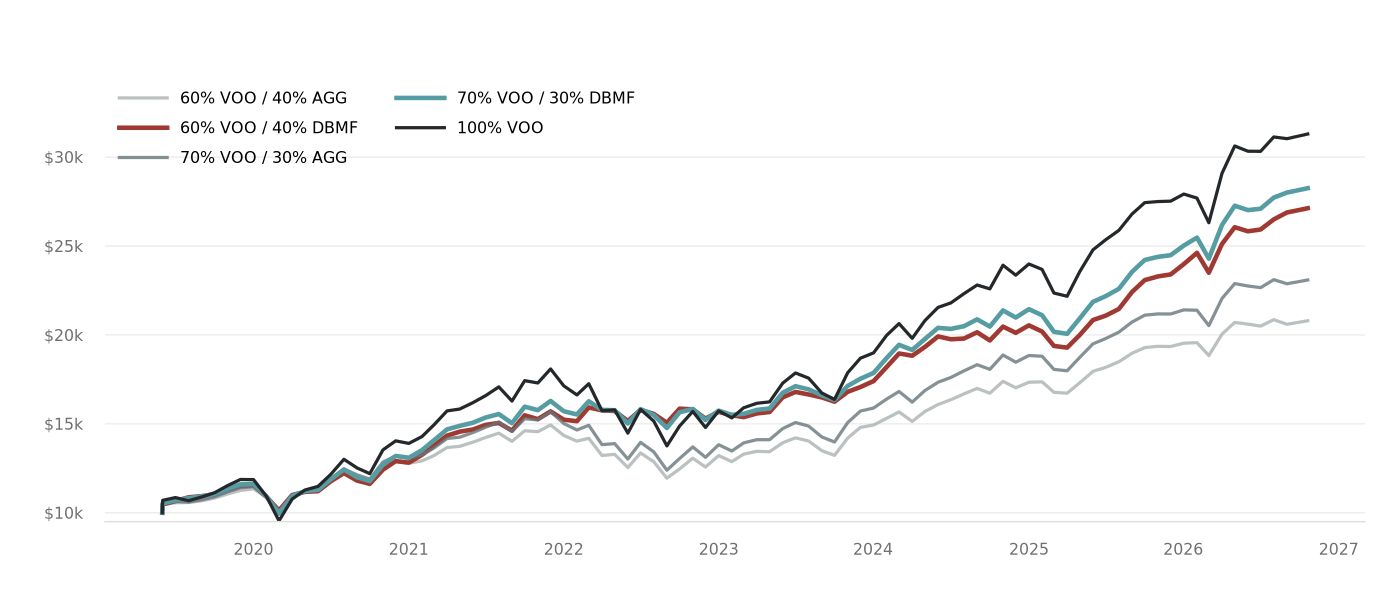
Illustrative historical backtest using ETF market-price total returns with distributions reinvested. Allocations are reset monthly. The test begins May 31, 2019, includes 88 complete months through September 2026, and adds a separately identified partial observation through October 20, 2026. Results exclude taxes and additional portfolio trading costs. Published monthly fund returns are rounded, making all results approximate.
The equity-only portfolio generated the greatest cumulative return. That's hardly surprising given the strength of the stock market over much of this period.
But the most interesting result isn't which portfolio finished with the highest balance.
It's what happened in 2022.
While VOO lost approximately 18% and the traditional 60/40 stock-and-bond portfolio declined nearly 16%, the 70/30 managed-futures allocation lost approximately 6.6%.
And the comparison becomes even more compelling when we hold the equity allocation constant.
A portfolio consisting of 60% VOO and 40% AGG declined approximately 15.8% in 2022. Replace AGG with DBMF, keeping the same 60% equity allocation, and the loss falls to approximately 2.6%.
That's a difference of more than 13 percentage points during one of the most challenging years for traditional stock-and-bond diversification in decades.
The managed-futures portfolio still lost money. But it preserved substantially more capital without requiring investors to reduce their equity allocation.
Interestingly, this hasn't been limited to downside protection.
Through October 20, 2026, the hypothetical 70/30 VOO/DBMF portfolio had gained approximately 15.4% year-to-date, compared with 13.7% for VOO alone. A 60/40 VOO/DBMF allocation had gained approximately 15.9% over the same period.
I don't expect managed futures to outperform equities every year. They won't. DBMF itself struggled in 2023 while stocks rallied strongly.
And there's an important limitation to this test. DBMF's history only begins in 2019, and the sample includes an exceptionally favorable year for trend-following strategies. Selecting a fund after observing its historical performance also introduces hindsight bias.
None of this proves that the same allocation will perform as well in the future.
What interests me is the possibility of owning something capable of behaving differently when the rest of my portfolio is under pressure.
After all, diversification shouldn't simply mean owning more things.
It should mean owning things that respond differently to the risks that matter.
Rethinking the Next Generation of Portfolios
I have no intention of abandoning equities.
Ownership in productive businesses remains one of the most compelling ways to build long-term wealth, and I don't see that changing.
What I question is the assumption that bonds should automatically occupy the defensive portion of every diversified portfolio.
The problem isn't that bonds have lost their value. It's that investors have come to depend on a relationship that was never guaranteed in the first place.
For my purposes, combining broad equity exposure with managed futures offers a more compelling framework than mechanically maintaining a conventional 60/40 allocation.
It preserves meaningful participation in economic growth while introducing a strategy capable of responding to sustained market movements in either direction.
That doesn't mean I've found the perfect portfolio. I don't think one exists.
But I would rather construct a portfolio with the ability to adapt than rely entirely on historical relationships that may no longer hold when they're needed most.
The Federal Reserve will continue attempting to balance inflation, employment, growth, and financial stability. Interest rates will rise and fall. Markets will alternate between periods of optimism and fear.
And the economic aircraft will continue its oscillations.
Climb. Lose airspeed. Dive. Recover. Climb again.
Perhaps policymakers will find a way to stabilize the flight. Perhaps the system can sustain these oscillations for decades. I certainly don't pretend to have the answers.
But there is something unsettling about an aircraft repeatedly trading altitude for airspeed when nobody can say how much altitude remains.
The cycle can continue, again and again, until one day there simply isn't enough altitude left to recover from the next dive.
When that happens, what comes next is anyone's guess.
Tene Cursum